Origin
Aglaonema 'Silver Bay' originates from the tropical and subtropical regions of Asia and New Guinea. This plant species belongs to the Araceae family. Aglaonema is also known as the "Chinese evergreen," which refers to its high tolerance for low light conditions—a characteristic typically associated with hardy, evergreen plants.
Characteristics
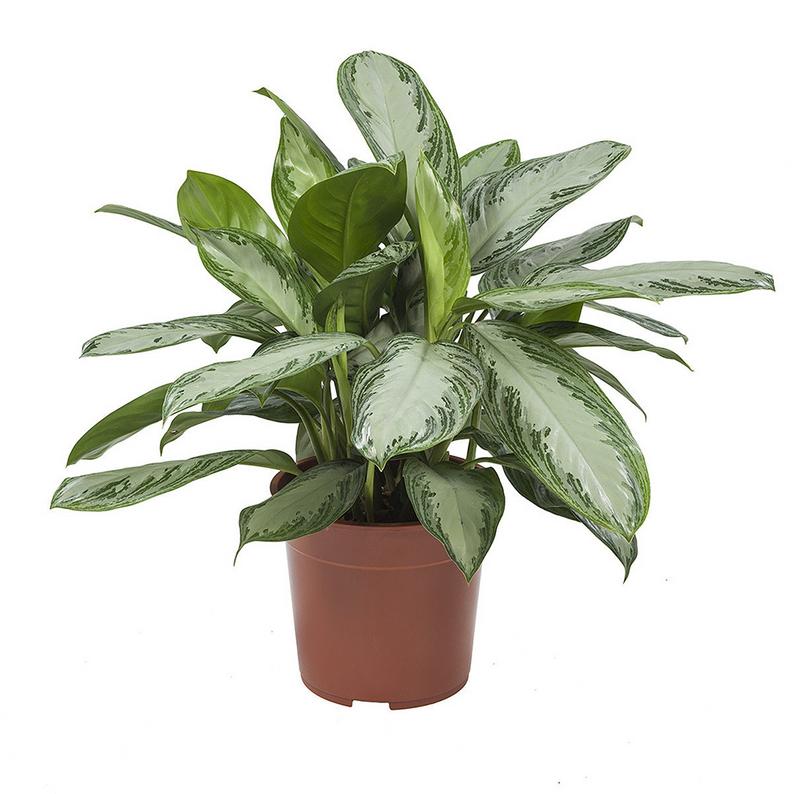
Aglaonema 'Silver Bay' stands out with its attractive leaves, which have a silvery pattern on a dark green background. The mature plant can reach a height of between 60 and 90 cm. It grows slowly and its leaves are supported by strong stems. Its flowers are small and usually bloom in summer, but they are not as striking as its beautiful leaves.
Care
Aglaonema 'Silver Bay' requires minimal care and thrives in a variety of environments. The plant prefers indirect light but will survive in shady locations. Ideally, the soil should be kept evenly moist, but the plant is also tolerant of drier conditions. It prefers medium to high humidity, making it suitable for bathrooms or kitchens. For optimal growth, keep the ambient temperature between 16 and 29 degrees Celsius.
A little extra tip for the crab flower:
-
Air-purifying champion: 'Silver Bay' is not only beautiful, but also one of the best air-purifying plants, as it effectively removes benzene and formaldehyde from the air in your room.
-
Toxic effect: It is important to know that all parts of Aglaonema are toxic (they contain calcium oxalate crystals), so it is best to place it where small children or pets cannot reach or chew on it.
-
Tips for a more lush form
-
The power of light: Although the text mentions that it tolerates shade, if you want it to produce new shoots more quickly, place it in a brighter location (but protect it from direct southern sunlight!). The more indirect light it receives, the more energy it will have to produce new leaves.
-
Cut back the flowers: If the plant produces flowers (which are small white spikes), it may be worth cutting them off. Flowering takes a lot of energy from the plant; if you remove them, the Aglaonema will use this energy to grow new leaves and shoots instead.
-
Rotation: Rotate the pot 90 degrees every two weeks! This way, all sides will receive equal light, and the plant will not "lean" or stretch in one direction, but will grow evenly all around.
-
Humidification: As a tropical plant, it produces larger and healthier leaves in more humid air. A lukewarm water shower once a week not only washes away dust (aiding photosynthesis), but also satisfies its humidity needs.
-
What else should you pay attention to?
If you see that the plant is very bald at the bottom, this is usually a sign of too little light or aging. In this case, it may be worth cutting back the longer stems in the spring, which you can easily root in water, and then replanting them next to the mother plant to achieve an even more lush effect.