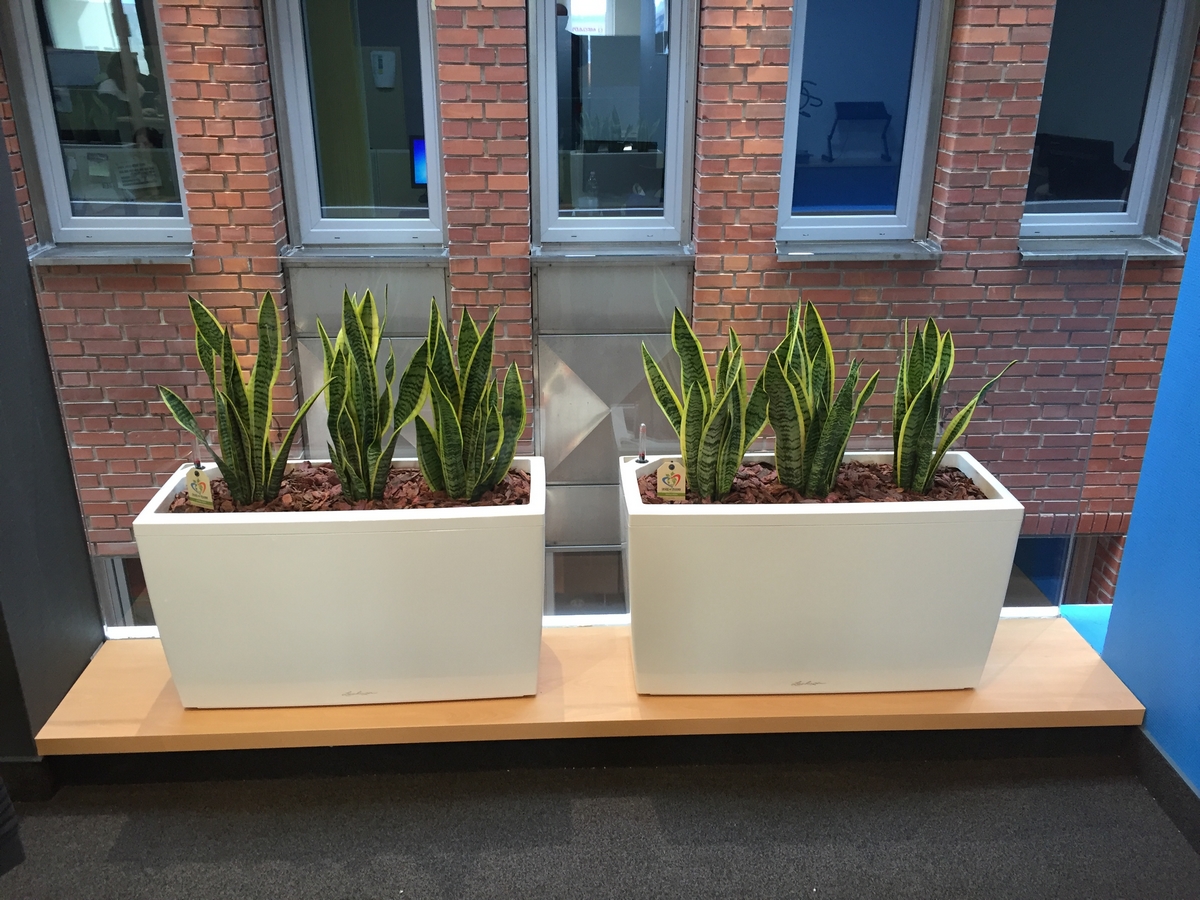
Sansevieria 'Laurentii' (Mother-in-law's tongue) – The most resilient air-purifying plant
Sansevieria trifasciata 'Laurentii', better known as mother-in-law's tongue or snake plant, has been a reliable decoration in Hungarian homes and offices for decades. This plant not only captivates with its elegant, upward-growing leaves, but also with its ability to survive in almost any conditions while continuously purifying the air in the room.
The origin of Sansevieria 'Laurentii'
Mother-in-law's tongue originates from the dry savannah regions of West Africa. In its original habitat, it adapted to variable humidity and low rainfall. Interestingly, in Africa it was traditionally cultivated for its strong fibers, which were used to make ropes, baskets, and textiles.
Characteristics and appearance of the plant
The 'Laurentii' variety is one of the most spectacular in the Sansevieria family:
-
Upward-growing leaves: Its long, sword-shaped, pointed leaves grow vertically, taking up little space.
-
Unique pattern: Its dark green leaves are decorated with distinctive bright yellow edges, and the leaf surface is covered with a marbling pattern reminiscent of tiger stripes.
-
Rare flowering: Occasionally, it may produce small, greenish-white, sweet-smelling flowers, although it is primarily kept as a houseplant for its decorative leaves.
-
Air purification: One of the most effective plants for filtering benzene and formaldehyde.
Caring for mother-in-law's tongue: Tips for the "immortal" plant
Sansevieria 'Laurentii' is so undemanding that it is often recommended even for those who have previously killed their cacti.
Light requirements and placement
Mother-in-law's tongue is one of the most flexible plants in terms of light:
-
Versatility: It can survive almost anywhere, from direct sunlight to complete shade.
-
Ideal location: It thrives best in diffused light, where its yellow edges remain bright. It grows more slowly in darker corners, but can tolerate lower light conditions.
Watering and nutrients
The rule here is: less is more!
-
Water requirements: Requires very little water. Allow the soil to dry out completely between waterings.
-
Dangers: Overwatering is the plant's greatest enemy, as standing water quickly causes root rot.
-
Fertilization: During the spring and summer growing season, it benefits from moderate fertilization, but in winter, fertilization should be suspended completely.
-
Mother-in-law's tongue is not only popular for its "survivability," but also has special properties that make it one of the most useful indoor plants.
Here's why it's worth keeping in your office and home (especially in the bedroom):
1. "Night shift" air purifier
Most plants produce oxygen during the day, but mother-in-law's tongue is one of the few that also releases oxygen at night while absorbing carbon dioxide.
2. Fighting invisible toxins
According to NASA research, spider plants can filter harmful substances such as benzene, formaldehyde, trichloroethylene, and xylene from the air.
-
These substances are often found in printer ink, furniture adhesives, carpets, and cleaning products, so spider plants act as a kind of natural filter.
3. A favorite of the "laziest" plant lovers
In an office environment, it is common for plants to be forgotten about during weekends or holidays.
-
Vacation-proof: It can go without watering for up to 2-3 weeks.
-
Light-independent: Since it can survive even in dim fluorescent light, it can be placed in meeting rooms or darker corners of the office where other plants would quickly die.
4. Aesthetics and space saving
Its upward-growing, rigid leaves take up minimal space.
-
It does not hang over the desk, does not obstruct traffic in the hallway, and gives the room an elegant, modern look.